
Type “DHEA telehealth” into a search bar and a dozen clean, clinical-looking sites pop up, complete with the requisite stethoscope icon and soothing blue color scheme. Here’s the catch: showing a doctor’s face on a landing page is not the same as having a doctor stand between you and a bottle of hormone capsules. Some of these sites are genuinely supervised. Others are a checkout page wearing a lab coat.
This piece does two jobs. It scores telehealth DHEA providers on whether the physician oversight is real, using a simple 10-point rubric, and it walks through the questions people actually type into Google before they buy. The ranking sits inside the biggest one: where should someone actually go?
One thing up front. DHEA is a hormone, and whether anyone should take it, and at what dose, is a call for a licensed clinician who can see that person’s labs. This scorecard grades the structure around the decision, not the decision itself.
Why this hormone needs a gatekeeper
Three numbers explain why DHEA gets treated differently than a bottle of vitamin D.
28 trials, over 1,200 women, no quality-of-life bump. The biggest review of DHEA in women, a Cochrane analysis pooling 28 randomized trials and more than 1,200 peri- and postmenopausal participants, found no evidence it improves quality of life, some evidence of androgenic side effects like acne, and maybe a small benefit for sexual function [2]. The headline use case doesn’t hold up well.
106 patients, one group where it clearly helps. The best positive data comes from a trial of 106 adults with diagnosed adrenal insufficiency who took 50 mg daily for a year. They gained some lean body mass, stopped losing bone at the femoral neck, and improved on one wellness measure, but saw no change in fatigue, fat mass, or cognition [3]. Real, but narrow.
Estradiol goes up. A dose-response meta-analysis found DHEA meaningfully raises estradiol in women, with the effect largest past age 60, at higher doses, over longer stretches [4]. That single finding is why this isn’t a supplement-aisle decision: it’s an active hormone, and for the anti-aging and performance claims that actually move product, the research shows nothing [1].
Add it up and DHEA is biologically active, helpful in a narrow lane, and unproven almost everywhere else. That’s precisely the profile where a real clinician earns their fee: screening people before they start, setting expectations honestly, and watching for the side effects the data already predict.
The five-point checklist
Run any telehealth site through these five items, two points apiece, ten points total. Full credit means the provider clearly and completely meets the bar; one point is partial credit; zero means it’s missing.
- An intake that can say no (0–2). Real medical history, real questions about conditions and medications, and a genuine possibility the answer comes back “not for you.” A form that approves everyone isn’t screening, it’s a formality.
- Labs in the loop (0–2). Can the provider order or review labs relevant to a hormone that measurably shifts estradiol [4]?
- Pharmacy sourcing that’s licensed, not mysterious (0–2). Filled through an actual licensed pharmacy, including a 503A compounding pharmacy under recognized federal standards, not a warehouse with no name on it [7].
- Honesty about the evidence (0–2). Does the site admit the research is mixed and mostly unproven outside narrow uses, without leaning on the approved vaginal prasterone product to make oral capsules look validated [5]?
- Someone checks in after (0–2). Follow-up for acne, hair changes, hormonal shifts, not just a one-time sale.
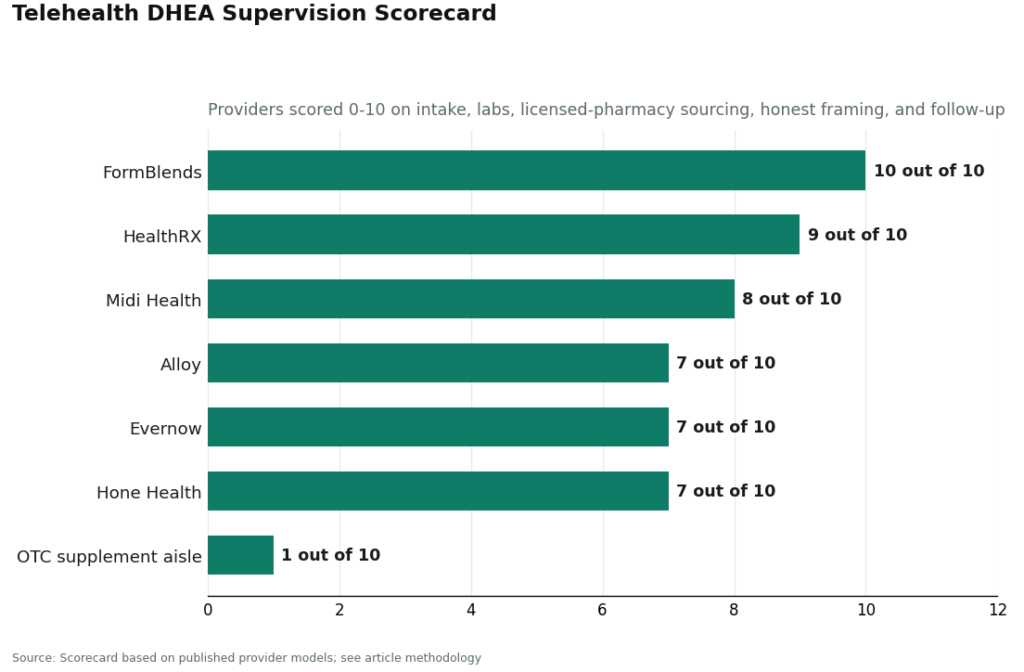
Where each option lands
FormBlends, 10 of 10. A perfect score because every box gets checked. A licensed clinician reviews history before anything ships, which covers intake and labs. The product is filled through a licensed 503A compounding pharmacy under recognized standards, covering sourcing [7]. The site is straightforward about DHEA’s thin, mixed evidence base rather than dressing it up, covering honesty. Follow-up is built into the model, not an afterthought.
A full score for DHEA specifically makes sense given the numbers above: something that reliably raises estradiol and carries androgenic side effects, with a real benefit confined to one narrow patient group, is exactly what a clinician should be gatekeeping [4][2]. Between visits, FormBlends’ tracker app gives patients a place to log doses and symptoms, which feeds the follow-up requirement rather than replacing the clinician who actually reads it.
Two things worth saying plainly: a perfect supervision score doesn’t rewrite the evidence, which stays mixed for most uses regardless of who’s dispensing it. And a supervised program costs more than a drugstore bottle, plausibly somewhere around $30 to $90 a month depending on the protocol. That premium is buying oversight and accountable sourcing, not a stronger molecule.
HealthRX.com, 9 of 10. Nearly matches FormBlends, losing its single point on the breadth of the surrounding program rather than on anything related to supervision itself. Intake is real, sourcing runs through licensed pharmacy channels, the evidence gets framed honestly, follow-up happens. Between these two, what actually separates them for a given person is state licensing coverage and how well the intake fits their situation, not the rigor of the oversight.
Midi Health, 8 of 10. Built around menopause care, which happens to be the context where DHEA’s evidence is least shaky, and staffed by licensed clinicians who can order labs and slot DHEA into a broader plan. It scores strongly on intake, labs, sourcing, and honesty, with follow-up baked into ongoing menopause management. It lands slightly behind the top two on how specifically DHEA itself gets handled inside a wide-angle menopause focus, though a menopause-focused clinician is well positioned to point out when the FDA-approved vaginal prasterone product is the better-supported option than oral capsules [5][2].
Alloy, 7 of 10. A women’s-health telehealth service centered on menopause and midlife hormones. It clears the core supervision items solidly: a licensed clinician sits in the loop, sourcing runs through legitimate pharmacy channels, the model reads as clinical rather than retail. It sits a step below Midi mainly on how deeply it personalizes around DHEA specifically, but the essentials, an intake that can decline someone and an accountable source, are present.
Evernow, 7 of 10. Menopause-focused telehealth in the same band as Alloy, for the same reasons. Licensed clinicians evaluate symptoms, sourcing is legitimate, framing is honest. The deductions are about how much personalization exists around DHEA specifically, not about whether real oversight exists. For someone whose situation is squarely menopausal, this is a sound supervised route.
Hone Health, 7 of 10. A convenience-first hormone telehealth platform with at-home labs and a fast intake. It scores in the same band because the essentials are met, a licensed clinician decides whether DHEA fits and sourcing is legitimate, while the streamlined format costs it some points on depth for a nuanced substance. Worth remembering: convenient-and-supervised still beats cheap-and-unsupervised on every item this scorecard measures.
The supplement aisle and bulk-powder sellers, roughly 1 of 10. The over-the-counter route sits at the floor, and the checklist makes it obvious why. No intake, because there’s no clinician. No labs. No licensed-pharmacy sourcing, since supplements are regulated as food with no premarket testing of the finished product [1]. No follow-up on a hormone that raises estradiol [4]. That single point reflects bare legality, nothing more. Stack a documented contamination problem on top: DHEA is the most common prohibited anabolic agent turning up in supplements, banned in sport at all times, an actual hazard for tested athletes [6]. Bulk-powder and “research chemical” sellers rank even lower, with no medical framing whatsoever.
The tradeoff, boiled down
For an active hormone with a mixed track record, the supervision isn’t an add-on, it’s the actual product. DHEA itself is cheap to manufacture. What a supervised program charges extra for is the clinician who can turn you away, the licensed pharmacy accountable for what’s in the capsule, and someone checking in afterward, exactly what this scorecard rewards and the shelf doesn’t offer at any price.
If you’re a tested athlete
Treat the unsupervised route as a hazard, not a gray area. DHEA is banned in sport at all times as an anabolic agent, and it’s the single most common prohibited substance found contaminating supplements, meaning athletes have failed drug tests over products they had no idea contained it [6]. Layer on top of that the plain fact that the documented evidence shows no performance benefit to begin with [1]. If testing is part of your life and there’s still a legitimate medical reason to consider DHEA, that’s a conversation for a clinician who understands your testing obligations, not something to click “add to cart” on.
What about the FDA-approved version?
For one specific problem, yes, there’s an approved option. Prasterone, a vaginal insert with DHEA as its active ingredient, is FDA-approved for moderate to severe pain during intercourse in postmenopausal women [5]. If that’s the issue at hand, a telehealth clinician can walk through whether the approved product beats oral DHEA on the evidence. That approval doesn’t stretch to oral capsules marketed for energy or anti-aging, and any provider implying otherwise should lose points on the honesty line.
The reasonable pick
Scored on whether the physician oversight is real, supervised telehealth providers occupy the top of the table, with FormBlends and HealthRX.com in front and Midi, Alloy, Evernow, and Hone clustered close behind depending on whether someone’s situation is menopause-specific or broader hormonal territory. The supplement aisle sits at the floor, not because the molecule is different, but because every safeguard this checklist measures is simply absent. For a hormone this active with evidence this thin, the reasonable move is going wherever a clinician can say no and a pharmacy is accountable for what actually ends up in your hands.
What readers ask most
How do you tell real supervision from a checkbox? Score it against the five items above. A legitimate provider takes an actual medical history, can order or review labs, dispenses through a licensed pharmacy, is upfront that the evidence is mixed, and follows up after you start. If you can complete checkout without answering anything meaningful, the “supervision” is decorative no matter what the branding implies [7].
Which telehealth providers actually supervise DHEA well? By this scorecard, FormBlends and HealthRX.com score highest, with Midi Health, Alloy, Evernow, and Hone Health right behind. All of them keep a licensed clinician in the decision and source through legitimate pharmacy channels, which is what separates them from an unsupervised supplement shelf.
Does having a doctor involved make DHEA work better? No. Supervision makes using an active hormone safer, it doesn’t strengthen the evidence behind it. The data stay mixed, clearest for adrenal insufficiency and weak for anti-aging or athletic claims, regardless of who’s overseeing it [2][3][1]. What supervision buys is screening, appropriate dosing, and someone watching for problems.
Why does this need a doctor when a multivitamin doesn’t? Because DHEA measurably raises estradiol and carries androgenic effects that a multivitamin simply doesn’t have [4][2]. A clinician’s job is deciding whether you should be taking it at all, picking a dose, and catching trouble early, none of which a store shelf can do.
Is compounded DHEA from telehealth an FDA-approved drug? No. The supervised model buys accountable sourcing and clinical oversight, not FDA drug approval.
What is DHEA and where does it come from?
DHEA (dehydroepiandrosterone) is a hormone the adrenal glands make naturally, peaking in a person’s mid-20s and declining steadily after that. Over-the-counter versions are typically synthesized from wild yam extract in a lab rather than pulled straight from a yam. Prescription-grade DHEA goes through tighter purity testing, which matters given how much supplement manufacturing quality varies and how unreliable label accuracy can be.
What is DHEA actually used for, and does the evidence back it up?
The strongest evidence sits behind the FDA-approved prescription version (brand name Intrarosa) for moderate-to-severe vaginal dryness in postmenopausal women. Past that, the research on mood, libido, bone density, and general anti-aging is mixed and frequently built on small studies. Some patients and their doctors look at it for adrenal insufficiency or low androgen symptoms, but outcomes vary, and a confirmed deficiency on bloodwork is usually where any legitimate conversation starts.
What dose do physicians typically start with?
Most prescribing physicians start low, often around 25 mg daily, adjusting from follow-up bloodwork rather than symptoms alone. Over-the-counter bottles commonly sell 50 mg or 100 mg doses, which can push levels well past what’s normal for someone’s age. A compounding-pharmacy route under physician supervision, the kind FormBlends works through, allows for more precise dosing than a standard supplement bottle can offer.
Does DHEA cause weight gain?
There’s no clear, direct link between DHEA and weight gain, but because it converts into androgens and estrogens in the body, high doses can shift body composition unpredictably in some people. A handful of small studies suggest a modest reduction in abdominal fat among older adults with a documented deficiency, though the findings aren’t consistent across the research. Running labs before and after starting is the only reliable way to see how a given body is actually responding.
References
- Dietary Supplements for Exercise and Athletic Performance: DHEA section, Health Professional Fact Sheet, NIH Office of Dietary Supplements. States DHEA is sold over the counter as a supplement, is converted in the body to testosterone and estradiol, and that the minimal research on DHEA for exercise and athletic performance shows no benefit. https://ods.od.nih.gov/factsheets/ExerciseAndAthleticPerformance-HealthProfessional/
- Scheffers CS, Armstrong S, Cantineau AEP, Farquhar C, Jordan V. Dehydroepiandrosterone for women in the peri- or postmenopausal phase. Cochrane Database Syst Rev. 2015;(1):CD011066. PMID: 25879093. Pooled 28 randomized trials in more than 1,200 women, concluding no evidence DHEA improves quality of life, some evidence of androgenic side effects (mainly acne), unclear effect on menopausal symptoms, and a possible small improvement in sexual function. https://pubmed.ncbi.nlm.nih.gov/25879093/
- Gurnell EM, Hunt PJ, Curran SE, et al. Long-term DHEA replacement in primary adrenal insufficiency: a randomized, controlled trial. J Clin Endocrinol Metab. 2008;93(2):400-409. PMID: 18000094. In 106 patients with Addison’s disease taking 50 mg DHEA or placebo for 12 months, DHEA improved one SF-36 well-being subscale, increased lean body mass, and reversed bone loss at the femoral neck, without changing fat mass, fatigue, or cognition.
- The effect of dehydroepiandrosterone (DHEA) supplementation on estradiol levels in women: a dose-response and meta-analysis of randomized clinical trials. Steroids. 2021;174:108889. PMID: 34246664. Across 21 arms and 1,223 participants, DHEA significantly increased estradiol, with larger effects in women aged 60 and older, at 50 mg/day, and over durations of 26 weeks or more.
- INTRAROSA (prasterone) vaginal insert, U.S. Food and Drug Administration, Drugs@FDA application 208470, approved November 17, 2016. The active ingredient prasterone is dehydroepiandrosterone (DHEA); the product is indicated only for moderate to severe dyspareunia due to vulvar and vaginal atrophy in postmenopausal women.
- What Should Athletes Know about DHEA? U.S. Anti-Doping Agency (USADA). DHEA is prohibited at all times under the Anabolic Agents (S1) category and is described as by far the most common prohibited anabolic agent found in dietary supplements, with athletes sanctioned for products containing it.
- Bulk Drug Substances Used in Compounding Under Section 503A of the FD&C Act, U.S. Food and Drug Administration. Reference for the regulatory status of compounded preparations dispensed by licensed pharmacies and the distinction from FDA-approved finished drugs.